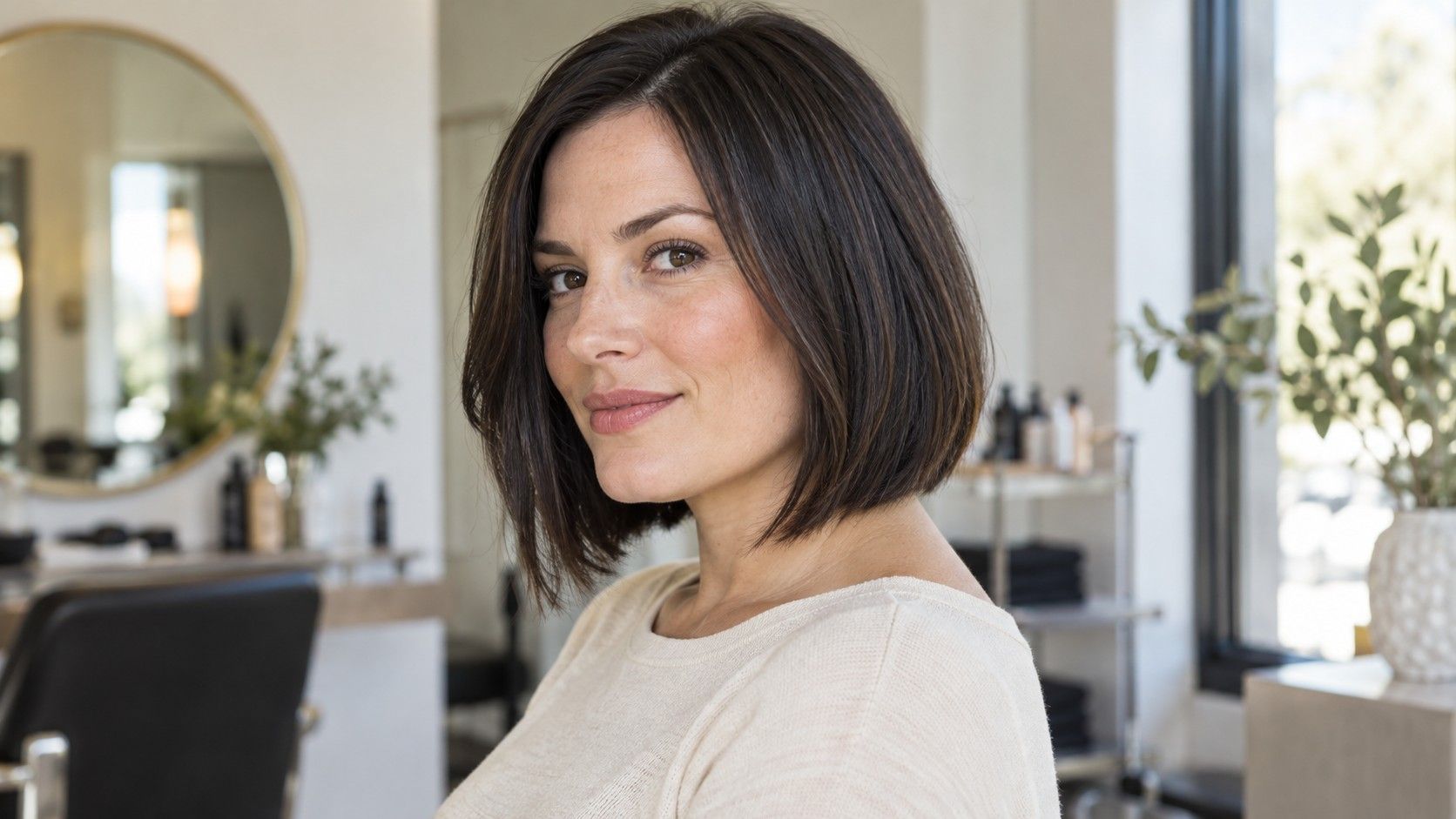
Bangs change how much forehead you see and where the hair draws a line across the face. They do not need to hide an angular jaw. You might want a sharp fringe that repeats its geometry, a long sweep that opens one side, or a divided shape that leaves the center visible. Choosing bangs for square face proportions works best when the desired effect meets the way your front hair actually grows.
Decide what you want the fringe to change
Pull your hair back and look at the full outline before choosing a fringe. Notice the relationship between forehead width, cheekbones, jaw width and face length. A square outline can be relatively short or quite long. Covering much of the forehead makes less of that length visible, which you may enjoy on a longer face and dislike on a shorter one. The face shape label alone cannot settle that preference.
Hold a section across your forehead, then move it diagonally. Compare the two in a mirror at normal conversation distance. A straight line creates a clear upper boundary; a diagonal exposes more forehead on one side. Take a photograph from eye level if it helps, keeping the camera away from your face. Close selfies can exaggerate the proportions you are trying to compare.
Be specific about your aim. “I want more attention around my eyes” leads to a different discussion from “I want the front out of my face.” If the second request matters most, bangs might add an unwanted daily task. Long face framing pieces that tuck behind the ears can give a new outline with less hair falling forward. Leaving the forehead open is also a complete styling choice.
Try curtain bangs with your natural parting
Curtain bangs divide around a part, with shorter sections near the center and longer pieces toward the sides. The exact landing points matter more than the name. A short central section can sit around the brows, while a longer version may begin near the eyes or cheekbones. Ask the stylist to point to the shortest dry length and show how it connects with the rest of your haircut.
When comparing curtain bangs on a square face, check where the longer sides end. Pieces stopping beside the jaw corner draw a different frame from pieces continuing below it. You can choose either effect deliberately. A fringe that curves outward near the cheekbones may add width there; one that drops more vertically may create a narrower opening around the center of the face.
Your natural parting affects the effort required. A strong side part or front cowlick may resist the symmetrical sweep in a reference picture. Try dividing your existing front hair while damp, then let it dry in that position. This will not reproduce a haircut, but it shows whether the roots separate willingly. Ask how much brush work the proposed fringe would need on an ordinary morning.
Longer curtain pieces are often easier to tuck or clip, although they can still fall into the eyes before reaching a useful length. Test your glasses and usual headphones during the consultation. A frame arm can push one side out, and a headset can flatten a carefully styled curve. A slightly longer first version gives you room to learn what you like before shortening the center.
Compare a side sweep with a full fringe
A side swept fringe moves across the forehead from a part and creates an asymmetric line. Choose the direction by trying both sides rather than assuming the current part is fixed. One direction may sit more naturally because of root growth. Also check which eye becomes partly covered and whether you keep moving the hair aside; a photograph cannot show that small but persistent annoyance.
A full fringe places a stronger horizontal edge above the eyes. A dense, straight edge can echo a defined jaw and make the haircut look deliberately geometric. A lighter or broken perimeter changes the texture of that line. Neither approach automatically looks softer in every setting: density, contrast with your skin and the width of the fringe all affect the result.
Ask how far the fringe section will extend toward the temples and how deeply it will be taken from the top. A wide, deep section removes more hair from the surrounding shape. That may be welcome in dense hair and less useful if you want to preserve full sides. Before cutting, have the stylist show the section so you understand which hair will become fringe.
Compare the front with your hair loose and tied back. A full fringe can feel balanced with a ponytail but crowded beside a dense bob. A side sweep might disappear into longer layers when worn loose. Choose the option that works in your main everyday arrangement, then decide whether the alternative needs a clip, a different part or a small styling adjustment.
Account for cowlicks, curls and changing length
A cowlick near the front can split a fringe or lift one corner. More hair in the section may add weight, but that is not a guaranteed solution. Ask the stylist to inspect the roots before wetting the hair and explain how the fringe will sit without a blow dry. Sometimes a longer divided shape works with the split more comfortably than a short straight edge.
With curls and waves, discuss the finished dry length. Stretching a curl to brow level while wet does not mean it will stay there. Different sections can shrink by different amounts, so the final outline needs assessment in its natural pattern. Bring a photograph of a typical home wash day if you arrive with your hair stretched, straightened or tied up.
Fine hair may separate across the forehead, especially after product or contact with the skin. Thick hair can feel warm or heavy in a full fringe. Neither texture rules out bangs, but the amount of hair and perimeter should be considered together. Tell the stylist if you dislike seeing gaps or if a dense panel feels uncomfortable; those preferences change the cutting choices.
Test the commitment before the scissors
A temporary clip in fringe can help you compare coverage, provided its color, texture and thickness are reasonably close to your hair. It is a visual test, not a reliable prediction of how your own roots will behave. Wear it with glasses and look from the side. Check whether you enjoy having hair above your eyes after the novelty of the first mirror view passes.
You can also pin the ends of a front section forward to suggest a fringe. This is less realistic, but useful for comparing an open forehead with a covered one. Avoid treating a face filter as a precise cutting plan. Filters often alter volume, texture and even face proportions at the same time, leaving the stylist with a result your actual hair cannot reproduce.
Bring two or three images and name the detail you want from each: the central opening, the eyebrow length, the temple coverage or the blend into the sides. Include the detail you want to avoid. “No short pieces that stand up at the temples” is more useful than asking for the most flattering bangs. Agree on a conservative first length if you remain uncertain.
Choose a routine you will repeat
Ask for a demonstration using your normal tools. A rounded curtain sweep may need damp roots redirected with a dryer and brush; a curl fringe may need a small refresh of individual sections. Learn the minimum sequence rather than watching a full salon finish without explanation. The important question is whether you can recreate an acceptable everyday version, not the most polished possible version.
Bangs may need washing or refreshing sooner than the rest of the hair because they touch the forehead and are handled often. Keep product light at first and adjust with advice suited to your texture. If you use heat, follow the tool and product instructions. A fringe that only behaves with repeated intensive styling may be a poor match for a low effort routine.
Finally, discuss trims and the path back to a longer front. Ask when the shortest pieces are likely to interfere with your vision and what you can clip as they grow. After the first home wash, notice the root direction, the point where the sides land and whether the fringe feels comfortable. Those observations make the next adjustment specific, without turning a square jaw into a problem to solve.